|
|
|
|
| How to Increase Rent and Renew Leases in Seattle
|
|
|
|
|
This article is by Tiffany Caoili
|
|
|
Property taxes, insurance, utilities and repair costs tend to rise every year. When rent stays flat, those higher costs come straight out of the owner's return. In a rent controlled environment housing providers who fail to keep up with market rents get punished severely when they go to sell the property Because the next buyer may not be able to realize market rents for many years and thus can only pay a lower price for the property.
Regular rent increases help a rental property keep up. Modest, predictable increases cover rising expenses, pay maintenance and improvements, and keep rent in line with the market.
How often should you raise rent? Once a year is the most the law allows, and it's also a good rhythm for most owners. Even a small $25 per month increase sets the expectation that residents should expect an annual increase. Rent can't go up during a resident's first 12 months, and only one increase is allowed in any 12-month period. Review each unit at the same time every year, such as its lease anniversary, and base the increase on your costs and comparable rents. Some years, a small increase or none at all may make sense. Using the same written approach for every resident keeps things fair and makes your decisions easy to explain.
In Seattle, the biggest challenge is timing. The city's notice rules sit on top of the state's rent cap, so you'll need to decide on next year's rent about seven months in advance, and a small paperwork mistake can make a notice invalid. The steps below walk you through the process.
This article is general information, not legal advice. Laws change, so confirm current requirements before you serve a notice.
|
|
|
|
|
|
|
|
|
|
|
|
|
| Rule |
What it means for you |
| Notice period |
At least 180 days' written notice for any housing cost increase in Seattle (State minimum is 90 days) |
| Annual cap |
7% plus the Consumer Price Index, or 10%, whichever is less
|
| First year |
No increases during the first 12 months of a tenancy |
| When rent can change |
Only on month-to-month agreements or at renewal of term lease, never mid-lease and only at the start of a rental period |
| Large increases |
When the housing provider increases your housing costs by 10% or more within the same 12-month period, Resident may be eligible for Economic Displacement Relocation Assistance (EDRA).
Limiting the rent increase to 9.5% avoids this unnecessary expense. |
| Lease renewals |
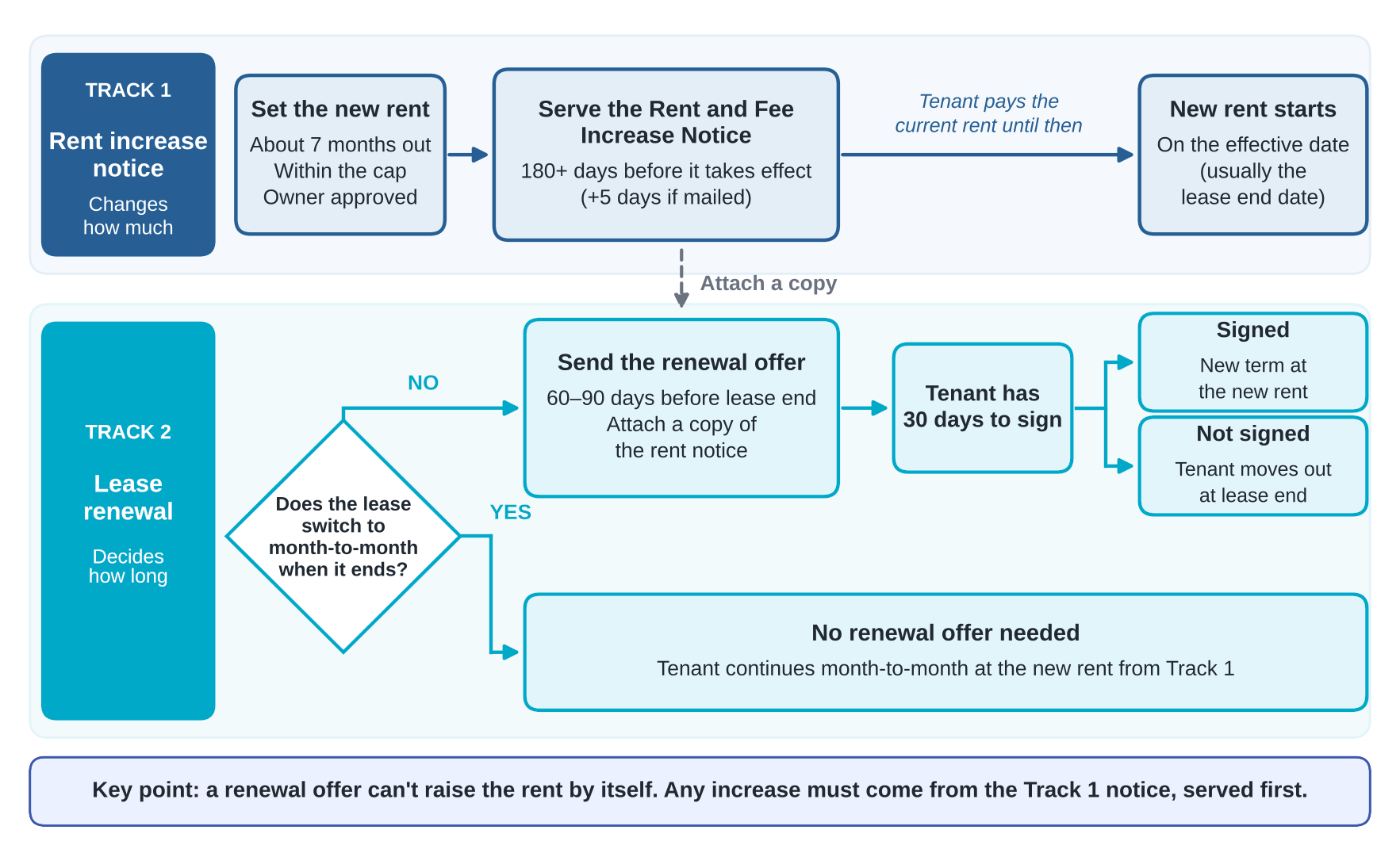
Serve the rent increase notice first, then formally serve the lease renewal offer 60–90 days before the fixed-term lease expires. Give the resident at least 30 days to respond. |
|
|
|
|
|
|
|
|
|
|
|
Rent Increase vs. Lease Renewal: How They Work Together
|
|
|
|
|
Step 1: Review which leases are coming up
-
Pull a list of upcoming lease expirations and each resident's last increase date.
-
Check each lease for month-to-month (MTM) conversion language. This decides whether you need a renewal offer (see Step 5).
-
Mark each resident's earliest eligible increase date. No increase can take effect in the first 12 months of a tenancy.
-
Track everything in one sheet: current rent, recurring charges, proposed rent, percent change and owner approval.
-
Review the proposed rent increases with the property owner and obtain approval before preparing and serving notices.
|
|
|
Step 2: Set the new rent within the legal limit
-
Know the cap.
Washington limits yearly increases to 7% plus inflation or 10%, whichever is lower. The State announces the next year's number each summer, shortly after inflation data is released in mid-July: 9.683% for 2026 and 10% for 2027.
-
Include all recurring charges.
The cap applies to rent plus any charge that's the same every month, such as parking, storage or a flat-rate utility fee. Utilities billed on actual usage, which change from month to month, generally don't count toward the cap.
-
Plan for 2027 now.
With Seattle's 180-day notice, an increase you announce today won't take effect until mid-2027, so the 2027 cap applies. For example, $2,000 rent could rise to no more than $2,200.
-
Watch for the timing gap.
Because Seattle requires 180 days' notice, increases that take effect in January or February must be noticed in July or August, often before the state has announced that year's cap. To stay safe, either keep those increases at or below 7% (the cap can only drop below 7% if prices actually fall), or set the effective date a little later so you can serve the notice after the new cap is published. This timing issue is one of the many reasons we prefer to let a lease convert to MTM at the end of the initial 12 month term rather than continue with annual term lease renewals.
-
Keep month-to-month and lease rents close.
Month-to-month rent and lease rent can differ by no more than 5%, and both must stay within the cap. If you want to charge the 5% premium for the MTM rental agreement it must be included on the 180 day rent increase notice. We do not charge the premium to avoid this complication and challenging resident conversion.
-
Our approach: month-to-month after the first year.
At Medawar Real Estate, our leases automatically convert to month-to-month after the initial 12-month term instead of requiring residents to sign a new fixed-term lease. This eliminates the need for separate fixed-term renewal offers, including the associated 60–90-day deadlines and 30-day response periods. It also allows us to schedule rent increases independently of lease expiration dates, taking into account Washington State's annual rent increase cap, required notice periods, and other applicable regulations. This simplifies lease administration while giving residents more flexibility. Owners also have more flexibility in the event regulators change the laws and invalidate previously served rent increase notices, which has happened before.
-
Watch the 10% mark.
If increases add up to 10% or more within 12 months, Seattle requires an Economic Displacement Relocation Assistance (EDRA) notice. Tenant households earning 80% or less of the area median income (AMI) who move out instead of paying the increase may be owed up to three months of housing costs.
-
Be consistent and keep records.
Base increases on costs and market data, use the same approach for every tenant, and keep notes on how you set rents. An increase within 90 days of a tenant complaint or similar action is presumed to be retaliation unless you can show otherwise, so good records matter. properties, consistent recordkeeping will be particularly important.
|
|
|
Step 3: Prepare the notice
Use Washington's Rent and Fee Increase Notice to Residents form (RHAWA's Rent Increase Notice form follows the required state format) and fill in:
-
-
-
-
Each recurring charge (rent, utilities, parking, storage, other fees) with old and new amounts
-
-
Seattle-specific:
the notice must include the City's Renting in Seattle language, including the helpline (206) 684-5700 and
www.seattle.gov/rentinginseattle
. A notice missing this language is unenforceable and must be reissued.
Keep in mind that other cities, such as Tacoma and Olympia, may have their own rent increase rules and notice requirements. Always check local regulations before issuing a rent increase notice.
|
|
|
Step 4: Serve the notice and keep proof
-
Count the days.
180 full days, not counting the day of service. Example: for a June 1 increase, the resident must receive notice by December 2. Add five extra days if any part of service is by mail. For all intents and purposes, 185 days is the deadline to account for mailing times.
-
Serve it correctly.
Deliver the rent increase notice to each resident personally or, if personal delivery cannot be completed, leave a copy with someone of suitable age and discretion at the unit or post it in a conspicuous place, such as the front door, and mail a copy by first-class mail. When mailing notices, address them to the residents listed on the lease and keep records of service.
-
Make enough copies.
For in-person service, prepare one copy per adult resident. If posting and mailing, prepare one copy per resident for posting and another for mailing, plus one additional copy for each method addressed to "All Other Occupants or Persons in Possession." Each mailed copy should be sent in a separate envelope. The additional copies account for anyone living in the unit who may not be individually named on the notice.
-
Document it.
Complete a Declaration of Service (date, time, method, names, copies served), ideally the same day, and save it with a copy of the notice in the resident file.
-
Notify assistance providers.
If a housing authority or other program pays part of the rent, send it a copy of the notice.
-
Update your system.
Schedule the new rent and charges so the ledger changes on the effective date.
|
|
|
Step 5: Send the renewal offer
-
Serve the rent increase first.
Seattle's 180-day notice comes well before the 60–90-day renewal window, so serve the rent increase notice first. Then send the renewal offer.
-
Lease convert to MTM?
No renewal offer is required, though you can offer a new term if the resident asks.
-
Lease does not convert?
In Seattle, offer a reasonable renewal 60–90 days before the lease ends (SMC 7.24.030.J). The tenant has 30 days to respond. If you don't plan to renew, you'll need a qualifying just-cause reason under Seattle's Just Cause Eviction Ordinance (SMC 22.206.160.C) and applicable state law (RCW 59.18.650), with notice provided within the timeframe required by law for that specific reason.
-
Give time to respond.
Residents get at least 30 days to review the offer. A simple practice: set the response deadline 30 days before the lease end date.
-
Match the numbers.
The rent and charges in the renewal must match the increase notice you already served. A renewal is not a shortcut around the 180-day notice.
|
|
|
What happens if it goes wrong
Failing to follow Washington's rent increase requirements can lead to costly consequences. If a housing provider raises rent above the legal limit without a valid exemption, residents may have the right to terminate their lease with 20 days' written notice after giving the housing provider an opportunity to correct the increase. Housing providers may also face legal action, financial damages, attorney fees, and civil penalties of up to $7,500 per violation. Following the proper procedures helps property owners avoid unnecessary costs and legal disputes.
How we can help
At Medawar Real Estate, we manage the entire rent increase and lease renewal process for property owners, from tracking eligibility dates and calculating allowable increases to preparing and serving notices, maintaining proper documentation, and sending timely renewal offers. Our goal is to help owners maximize their rental income while staying compliant with Seattle and Washington for rental regulations.
Contact us today to learn how we can help manage your rental property!
|
|
|
|
|
|
|
|
|
|
|